
Article
November 16, 2026
Beneficial owners: why the register was never enough, and how to run the double check


Identifying the true beneficial owners of a legal entity is one of the main operational challenges when designing and rolling out onboarding and ongoing business-relationship monitoring.
When beneficial ownership registers were created around the world, we compliance professionals thought the problem was solved and that onboarding would become far simpler.
Unfortunately, in November 2022 the CJEU ended public access to the registers, and several Member States closed them.
We also know that the quality of register data is far from stellar. A 2023 study by Transparency International France (with Transparency International and the Anti-Corruption Data Collective) found that nearly a third of French companies had still not declared their beneficial owners. And among those that had, at least 5% listed only their legal representatives.
At Ondorse, we deal with this issue every day and want to share our view on it, particularly in light of the AMLR and AMLA's draft technical standards.
To go further, here is the Transparency International France report cited in the introduction.
The register identifies, the second source verifies
Checking the beneficial ownership register (“UBO”) is mandatory, but on its own it is never enough to verify a beneficial owner: you need a second source. This is not new: since 2015, the 4th Directive has prohibited relying exclusively on the central register (Art. 30(8) of Directive 2015/849).
In practice, how do you run this double check without asking every client for every document? The AMLR, applicable from 10 July 2027, and AMLA's draft regulatory technical standards (“RTS”) on customer due diligence set out the method. It comes down to one principle and four steps.
The principle: measures proportionate to risk
Art. 20(1)(b) AMLR requires you to identify the UBOs and take “reasonable measures” to verify their identity. The goal: to be satisfied that you know who they are and that you understand the client's ownership and control structure.
“Reasonable” means proportionate to risk. The obliged entity determines the extent of the information to consult based on the money laundering and terrorist financing risks posed by the legal entity it is onboarding, including those linked to the company's ownership structure (Art. 22(7) AMLR) and to any complexity in it. The text therefore does not set a number of documents, but an approach.
Assessing each client file case by case does not work at high volumes. To standardise your risk-based approach, we recommend analysing the recurring risk factors in your client base (number of ownership layers, company types, country of incorporation, etc.) and turning them into automated triggers.
What the AMLR and the draft RTS provide are practical, step-by-step markers (see also the table at the end of the article).
Step 1: identify the UBOs and understand the ownership and control structure
Since the regulation requires the source to be reliable, we recommend starting from the central UBO register and recording the date of consultation in the client file. That date will attest to how current the source is and, therefore, to its reliability.
If the structure includes one or more intermediate companies between the client and its UBOs, the RTS lists the information to obtain on each one (Art. 11(2)):
- legal form;
- country of incorporation;
- any shareholders or directors acting on behalf of a third party (nominees);
- shares held and voting rights, as a percentage;
- where applicable, listing on a regulated market.
How do you know whether there are intermediate companies?
The UBO register states whether ownership is direct or indirect, but does not always describe the ownership chain. If ownership is indirect, automatically ask the client for its ownership chart. The AMLR requires it to provide you with information on its owners and UBOs (Art. 63). Then verify each intermediate company in its own register.
At this stage, flag the complexity factors listed in the RTS (Art. 11(4)): number of intermediate layers, trusts or similar legal arrangements, companies incorporated in a high-risk jurisdiction, nominees. These are what will determine the next steps.
Step 2: choose the second source according to the level of due diligence
The AMLR and the RTS require a second source, not a systematic document from the client. The RTS gives an indicative list (Art. 10): public registers other than the central register (trade register, tax register, etc.), reputable data providers, credit or financial institutions, group entities, and documents of the entity naming the UBO with certified identity.
The KYC due diligence level determines the nature of the second source.
| Due diligence | What the texts say | Recommended second source |
|---|---|---|
| Simplified | Identification via one source (central register, trade register, client information, reliable open source), verification via another source from this list, other than the central register (RTS Art. 19) | No document: a trade register extract or the information provided by the client is enough. If any doubt arises, the file moves back to standard due diligence. |
| Standard | Reasonable measures proportionate to risk, central register as a complement (Art. 22(7) AMLR); information on each intermediate entity (RTS Art. 11(2)) | A public register is enough if the structure is simple and clear. A document becomes necessary as soon as a complexity factor appears or a percentage cannot be read in any register: a cap table or shareholding chart, dated and signed by the legal representative, completes the verification, cross-checked against the central register. |
| Enhanced | Additional information to verify the UBOs or the structure (Art. 34(4)(a) AMLR; RTS Art. 21(a)); expert analysis or opinion for a complex structure or one with no apparent purpose (RTS Art. 21(d)) | Up-to-date register extracts and proof of ownership (share transfer register, list of partners or articles of association, depending on the legal form) for each intermediate company. For an opaque structure, an expert analysis or opinion on its rationale. |
In all cases, assess the reliability of the source you use: credibility, official nature and independence, how current it is, accuracy, ease of falsification (RTS Art. 8). The RTS recitals also ask you to take the date of the document into account.
A cap table provided by the client scores poorly on the RTS independence criterion (Art. 8): always cross-check it against an external source.
Step 3: compare the two sources
Now compare them point by point:
- UBOs' names and dates of birth;
- ownership percentages and voting rights;
- the ownership chain, layer by layer.
If there is a discrepancy with the central register, it must be reported to the body in charge of the register within 14 days (in France, for example, discrepancies are reported to Infogreffe) (Art. 24(1) AMLR). Under enhanced due diligence, reporting to the UBO register is mandatory, without first asking the client for clarification (Art. 24(2) AMLR).
Step 4: document and schedule the next periodic review
Record the decision: sources consulted, dates, discrepancies found and due diligence level applied. The obliged entity must be able to demonstrate to its supervisor that the measures taken are appropriate to the risks identified (Art. 20(4) AMLR).
With onboarding software, this audit trail is generated automatically with every decision, instead of being pieced together in a rush before an inspection.
Then schedule the review: at least once a year under enhanced due diligence. For other clients, set the frequency according to risk, without exceeding 5 years (Art. 26(2) AMLR). A change in the client's situation, for example a new shareholder1, requires an immediate review, whatever the schedule (Art. 26(3) AMLR).
How do you find out? The client must update the register within 28 days (Art. 62 AMLR), but nothing requires it to tell you spontaneously. Include a contractual notification clause: without these two mechanisms, a change of shareholder can go unnoticed until the next review.
1 The regulation does not require a client legal entity to notify an obliged entity of a change of shareholder, but the obliged entity can make it mandatory in its terms and conditions in order to be notified.
Example: an SAS owned by a foreign holding company
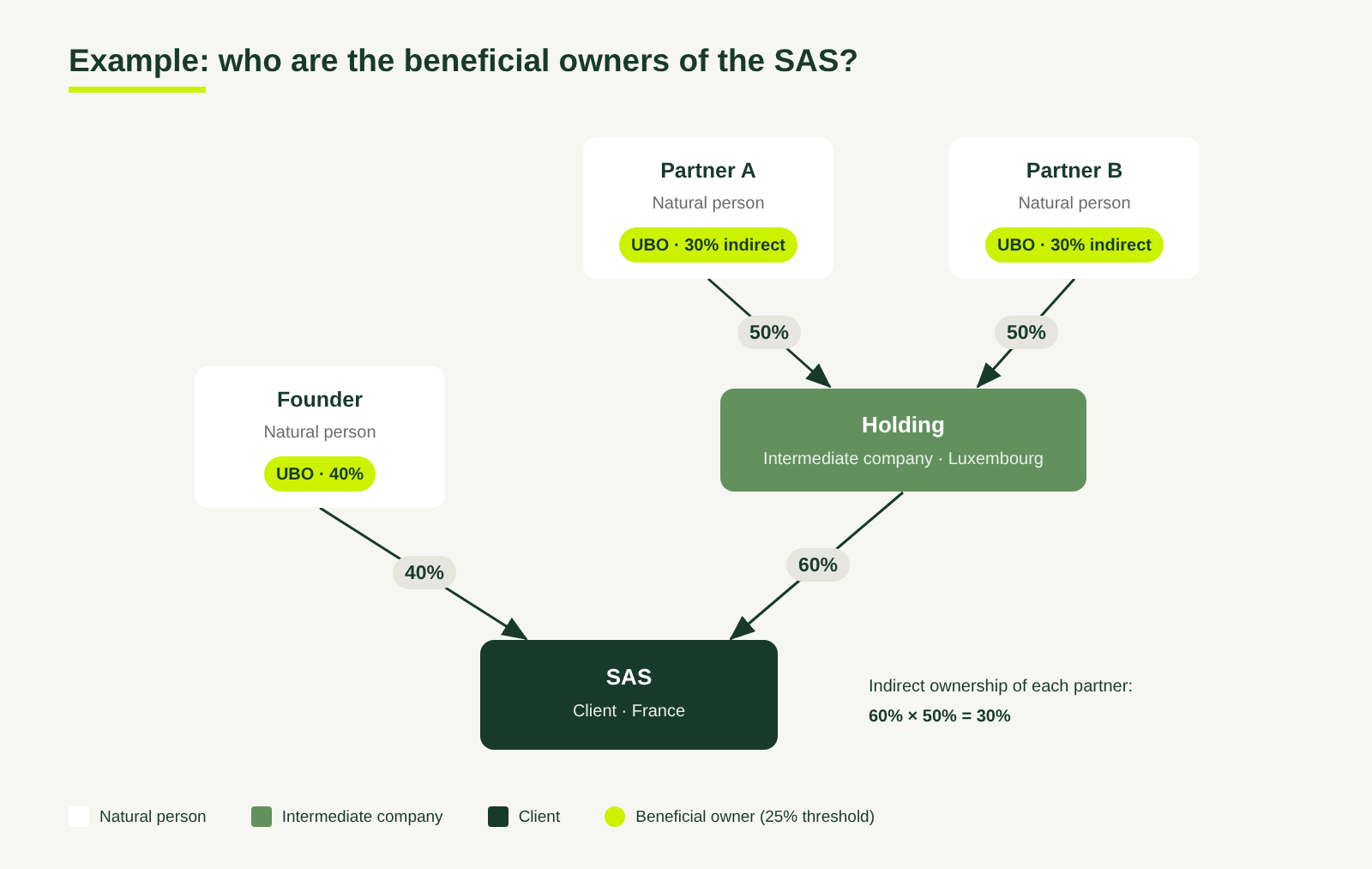
Fictional example. A French SAS is 40% owned by its founder and 60% owned by a Luxembourg holding company, itself owned in equal shares by two partners. All three natural persons are UBOs: the founder at 40%, each partner at 30% indirectly.
What threshold should you use to identify a UBO?
The AMLR uses direct or indirect ownership of 25% or more of the shares, voting rights or any other ownership interest (Art. 52(1)).
In France, for example, the current threshold is “more than 25%”. A partner holding exactly 25% will therefore become a UBO, which was not the case before the AMLR applied.
Step 1
The French central register is consulted. The structure includes an intermediate company, so you need to determine its legal form, country of incorporation and the breakdown of its share capital.
Step 2
Standard due diligence scenario
Check the Luxembourg trade register to confirm the holding company's legal form and registration. If the 50/50 split is not visible there, collect a cap table signed by the legal representative to complete the verification, and cross-check it against the French central register.
Enhanced due diligence scenario
For example, if the holding company were incorporated in a high-risk AML/CFT jurisdiction: collect the up-to-date register extract and articles of association of the holding company. If the holding company has no apparent economic rationale, document an analysis of its purpose.
Step 3
If the French central register lists only one of the two partners, report the discrepancy within 14 days.
Step 4
The decision is recorded and the next review is set according to the due diligence level. If your client informs you of a transfer of shares, trigger a review of the file immediately.
Configure triggers, not checklists
Asking every client for proof of ownership slows down onboarding and the customer journey, with no clear compliance benefit when the risk does not justify it. Never asking for it exposes you during a regulatory inspection.
The answer must lie in your risk policy: you need explicit triggers that are documented and applied consistently. These triggers let you set up business rules in your tool, making operations easier and avoiding needlessly burdening your onboarding and ongoing KYC processes.
At Ondorse, this is the logic we build tooling for: rules that trigger a document request based on the due diligence level, the structure and the freshness of sources, with a record of each decision automatically added to every file.
Going further: what has and hasn't changed since 2015
In substance, the AMLR carries over principles that the directives already set out and that each Member State transposed into its national law.
| Principle | Before the AMLR | AMLR and RTS | What changes (or not) |
|---|---|---|---|
| Reasonable measures to verify the UBO | Directive 2015/849, Art. 13(1)(b): “taking reasonable measures to verify that person's identity so that the obliged entity is satisfied that it knows who the beneficial owner is” | AMLR Art. 20(1)(b): “taking reasonable measures to verify their identity so that the obliged entity is satisfied that it knows who the beneficial owners are” | Nothing in substance. The RTS specifies the information to obtain for each entity in the structure (Art. 11(2)). |
| Extent of measures set according to risk | Directive 2015/849, Art. 13(2): “obliged entities may determine the extent of such measures on a risk-sensitive basis” | AMLR Art. 22(7): “Obliged entities shall determine the extent of the information consulted, having regard to the risks […], including the risks related to the ownership structure.” | The option becomes an obligation: “may determine” becomes “shall determine”. Risk linked to the structure is explicitly covered. |
| The central register is not enough on its own | Directive 2015/849, Art. 30(8): obliged entities “do not rely exclusively on the central register” | AMLR Art. 22(7): “In addition to the means of verification set out in the first subparagraph […], obliged entities shall verify beneficial ownership information by consulting the central registers.” | Principle unchanged. New: reporting a discrepancy within 14 days, with no exemption under enhanced due diligence (Art. 24). |
| Review when the client's situation changes | Directive 2015/849, Art. 14(5): “including at times when the relevant circumstances of a customer change” | AMLR Art. 26(3)(a): “the relevant circumstances of a customer change” | Trigger carried over word for word. New: maximum update periods of 1 year or 5 years (Art. 26(2)). |
| Risk-based UBO verification, register as a complement | French Monetary and Financial Code, Art. R. 561-7: “verify the identification details collected on that person using measures adapted to the money laundering and terrorist financing risk presented by the business relationship” | AMLR Art. 22(7)(b): “by taking reasonable measures to obtain the necessary information, documents and data from the customer or from other reliable sources, including public registers other than the central registers” | Principle unchanged. The AMLR applies without transposition, and the RTS lists the sources (Art. 10) and reliability criteria (Art. 8). |
| Ownership threshold | French Monetary and Financial Code, Art. R. 561-1: holding more than 25% of the share capital or voting rights | AMLR Art. 52(1): a direct or indirect interest “of 25% or more” of the shares, voting rights or any other ownership interest | A real change: a partner holding exactly 25% becomes a UBO. |
For an obliged entity in the EU, the framework is therefore already familiar, whatever its country. The AMLR harmonises and clarifies without changing the principle, with one concrete exception: the 25% threshold.
Cheat sheet: UBO double verification at a glance
The four steps above, summarised on one page. Save it or share it with your compliance team.
Regulatory references
- Regulation (EU) 2024/1624 (AMLR): Art. 20, 22, 24, 26, 34, 52, 62 and 63.
- AMLA, Final Report – Draft RTS under Article 28(1) AMLR, 30/09/2026: recitals (point 9); Art. 8, 10, 11, 19 and 21. Draft submitted to the Commission, applicable six months after its entry into force.
- Directive (EU) 2015/849: Art. 13, 14 and 30(8).
- French Monetary and Financial Code, Art. R. 561-7 and R. 561-1, version in force since 14 February 2020.
Discover our latest guide
Everything you need to know about this subject
Heading
Subtextt
ABOUT AUTHOR
SHARE ARTICLE


Talk with an expert
Short description
Similar articles



Ready to take the manual work out of KYC/B?
